

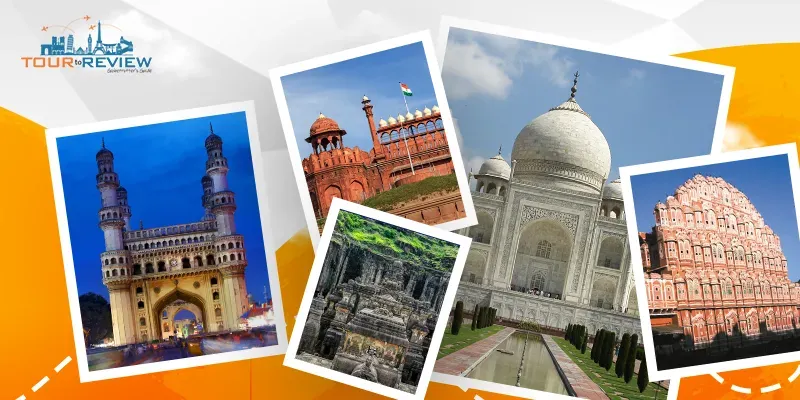
India is one such nation where history is relived through monuments, archaeological sites, and buildings. It has the audacity to take people to another era by giving them a peek into the glory of previous civilisations, which gives historical places in India their fascination. From the holy temples to the colossal forts, these places embody the rich cultural heritage of India.
Famous Historical places of India are not limited to bricks and stones only. They are history, culture, strength, devotion, and love. Each one of them has its own story to tell. Hence, India has become an extremely rich country with its incredible history. In this blog post, we will discuss the top 20 historical places of India.
Explore the Beauty of Historical Places in India
There are up to 44 UNESCO World Heritage Sites in India, along with many monuments that have been around for more than 5,000 years in the history of India. Therefore, whether you are a student who needs to write a history essay, a history enthusiast, or even a family on a historical trip, all you need to do is explore India’s historic destinations. Among India’s many heritage destinations, we have highlighted 20 notable historical places.
1.Taj Mahal – Agra, Uttar Pradesh
The Taj Mahal is indeed a world-famous monument in India and is considered to be one of the wonders of the world. Emperor Shah Jahan of the Mughal dynasty built it as a tribute to his wife Mumtaz Mahal. Construction of the Taj Mahal started in 1632 AD, one year after the demise of his wife.
2.Red Fort (Lal Qila) – Delhi
The Red Fort is known as one of the most prominent historical places in India, as well as an important symbol associated with India’s independence and national identity. This fort was built during the reign of Shah Jahan from 1638 to 1648. This fort served as the residence for the Mughal emperors for almost two hundred years. Some of the attractions that you would like to visit here include the Diwan-i-Aam, Diwan-i-Khas, Chhatta Chowk, and Nahr-i-Bihist.
3. Qutub Minar – Delhi
The Qutub Minar, the tallest brick tower ever built, is also one of the earliest examples of a marriage of Islamic and Indian architecture, blending Islamic structural forms with Indian craftsmanship and design. Qutb-ud-din Aibak built it in 1192 and completed it by his successor, Iltutmish, in 1220.
4. Agra Fort – Agra, Uttar Pradesh
Some of the most famous historical monuments found in India include the Agra Fort. The present Agra Fort was commissioned by Emperor Akbar in 1565 on the site of an earlier fortification. Akbar, Jahangir, and Shah Jahan expanded the construction of the Agra Fort in the year 1565.
5. Ajanta Caves – Maharashtra
In the list of 20 historical places in India, the Ajanta Caves comprise 30 rock-cut Buddhist monuments dating from the 2nd Century BCE to the 480 CE. Discovered in 1819 by a British officer, these caves have gained fame for the frescoes and elaborate sculptures they contain.
6. Ellora Caves – Maharashtra
Ellora Caves consist of 34 cave temples and monasteries that depict the artistic traditions of Hinduism, Buddhism, and Jainism from the 6th to 10th century CE. This is one of the biggest monoliths in the world, carved from a single rock, and dedicated to Lord Shiva.
7. India Gate – Delhi
India Gate commemorates over 74,000 soldiers of the British Indian Army who died in World War I and the Third Anglo-Afghan War, with more than 13,000 names inscribed on the monument. The tower is 42 meters tall, located on the Kartavya Path in New Delhi. India Gate was designed by Sir Edwin Lutyens and inaugurated in 1931.
8. Fatehpur Sikri – Uttar Pradesh
Fatehpur Sikri served as the capital of the Mughal Empire under Akbar from 1571 to 1585. The city is constructed mainly of red sandstone and features a blend of Persian, Timurid, and Indian architecture. Fatehpur Sikri is one of the finest historical places in India for learning about the Mughal Empire.
9. Elephanta Caves – Maharashtra
These caves, housing rock-cut sculptures honouring Lord Shiva and dating to the 5th to 7th centuries CE, are located on Elephanta Island in the Mumbai Harbour area. The thing that interests tourists most at this location is a rock-cut sculpture called Trimurti Sadashiva, standing six meters high.
10. Hawa Mahal – Jaipur, Rajasthan
The “Palace of Winds” or “Hawa Mahal” is a five-story building constructed in 1799 by Maharaja Sawai Pratap Singh. It is one of the 20 historic sites of India, featuring an exterior resembling a honeycomb, with 953 openings called “jharokhas.” Its primary purpose was for the ladies of the royal family to see street celebrations without being recognised.
11. Khajuraho Temples – Madhya Pradesh
The Khajuraho Group of Monuments is a UNESCO World Heritage Site, featuring amazing architecture in the Nagara style, along with erotic sculptures, built during the period 950-1050 A.D. by the Chandela dynasty.
12. Charminar – Hyderabad, Telangana
Charminar is an ancient monument and a mosque, constructed by Sultan Muhammad Quli Qutub Shah in 1591 to commemorate the end of a highly infectious plague that had ravaged Hyderabad at the time. There is also a small mosque in the upper story.
13. Mysore Palace – Mysuru, Karnataka
The well-known tourist site of South India that attracts millions of visitors annually is the Mysore Palace. This magnificent palace, built in the year 1912, depicts the grandeur of the Wodeyar dynasty.
14. Golden Temple – Amritsar, Punjab
The Golden Temple is the most sacred site for Sikhs and one of the religiously significant historical places in India. It receives more than 100,000 pilgrims daily. The community kitchen (Langar) at this temple operates around the clock for all.
15. Konark Sun Temple – Odisha
Konark Sun Temple is one of the finest examples of the Kalinga style, built in the 13th century. The temple depicts a colossal chariot with stone wheels and horses. This temple is dedicated to Lord Sun, Surya.
16. Meenakshi Amman Temple – Madurai, Tamil Nadu
The Meenakshi Amman Temple is one of the key pilgrimage destinations for South Indians, where the goddess Parvathi (Meenakshi) and Lord Shiva Sundareshwar are worshipped. Certainly, the Shiv bhakts urges do visit the temple once in their life.
17. Veerabhadra Temple– Andhra Pradesh
Veerabhadra Temple can be found in Lepakshi. This temple was constructed in the 16th century during the Vijayanagara dynasty. The temple is famous for its ‘hanging pillar,’ which appears not to fully touch the ground.
18. Pattadakal – Karnataka
Pattadakal is a heritage site in India, recognised by UNESCO. The place features numerous temples in the Chalukya architectural style, including both Nagara and Dravidian styles. Pattadakal is one of the historical places in India to visit with family.
19. Keoladeo National Park – Bharatpur, Rajasthan
Keoladeo, formerly known as Bharatpur Bird Sanctuary, is a UNESCO World Heritage Site that was once used as a hunting ground by the maharajas. More than 360 bird species, including Siberian cranes, pelicans, and herons, visit this sanctuary.
20. Hampi – Karnataka
Hampi was the capital of the Vijayanagara Empire (14th–16th centuries) and is one of the best historical places in Karnataka. The ruins are scattered across a dramatic, boulder-strewn landscape.
Discover, Experience, Remember
Exploring historical places in India is like turning the pages of a living history book. It may be either the grand Mysore Palace or the rich history of the Ellora Caves; each location offers you the chance to create an unforgettable experience. Each destination presents you with an occasion to explore, understand, and preserve the stories of the rich past of India. Hence, every time you get a desire to pay a visit to any of the famous places in India, pick any destination and travel back in time.