

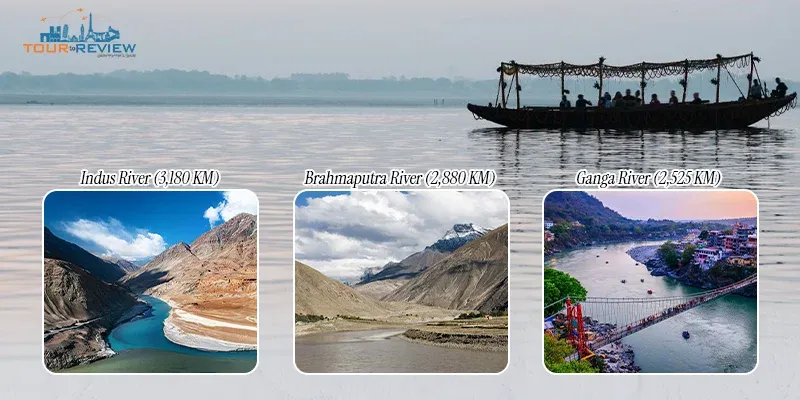
Rivers in India hold a very special place. Not only are they water bodies, but the lifeline of the whole nation. From the longest rivers in India to the shortest ones, they all support India from post to pillar. These rivers are essential to India’s economy, agriculture, and drinking water needs and hold quite substantial strategic significance.
This isn’t the end. In India, rivers play an important role. As a result, in most regions, these rivers are considered holy. This is one of the reasons why India takes its rivers so seriously. They are woven into India’s identity.
If you want to see how a river can be holy, necessary and loved, visit the location we are about to mention and experience a world unlike any other.
List of Longest Rivers in India Ranked by Length
Explore India largest river names depending on their length. We have curated this list from an authentic source. These water bodies are not only the largest but also surreal. Let’s witness the beauty of the longest rivers in India.
- Indus River (3,180 KM)
Origin – Lake Mansarovar in Tibet
Indus River, on which the country’s name originated, is India largest river name. India’s every river has a story. If not holy, the Indus River played a crucial role in the development of the ancient Indus Valley Civilisation and remains historically significant. Emerging from Mansarovar, passes through Ladakh and eventually enters Pakistan.
- Brahmaputra River (2,880 KM)
Origin – Angis Glacier in Tibet
The Brahmaputra is the 2nd longest river in India. It also holds importance in Indian history and culture, as it has been a lifeline for civilisations in the northern region. Brahmaputra is also known for its massive volume and religious significance.
- Ganga River (2,525 KM)
Origin – Gangotri Glacier in Uttarakhand
Ganga is third on the list of the longest rivers in India. Referred to as Ganga Maa, the Ganga River is the holiest river in India. The main spot where devotees take a holy dip is Har Ki Pauri in Haridwar. The river gets its name at the confluence of the Alaknanda River and the Bhagirathi River at Devprayag. This longest river flows through four states: Uttarakhand, Uttar Pradesh, West Bengal, and Bihar.
- Godavari River (1,465 KM)
Origin – Trimbakeshwar in Maharashtra
Godaveri is the 3rd India longest river name. It is considered 2nd longest river in South India and is also called the South Ganga and Dakshinn Ganges. After emerging from Trimbakeshwar, it flows towards Telangana and Andhra Pradesh and eventually meets the Bay of Bengal. The main tributaries of the Godavari River are the Purna, Pranhita and Indravati rivers.
- Satluj River (1,450 KM)
Origin – Rakshastal Lake in Tibet
Satluj is one of the five rivers of Punjab and among the longest rivers in India. It plays a crucial role in irrigation and hydroelectric power generation. Not only in India, but Satluj or Satlej is the major river of Asia and flows through China, India and Pakistan.
- Krishna River (1,400 KM)
Origin – Mahabaleshwar in Maharashtra
The sixth India longest river name is the Krishna River. It holds a prominent place for irrigation in Maharashtra, Andhra Pradesh, Telangana and Andhra Pradesh as it is the major source of water. It emerged from Mahabaleshwar and entered the Bay of Bengal after flowing through different states.
- Yamuna River (1,376 KM)
Origin – Yamunotri Glacier in Uttarakhand
The Yamuna River is one of the longest rivers in India, flowing through different states such as Haryana, Delhi, Uttarakhand, Himachal Pradesh and Uttar Pradesh. It eventually merges into the Ganga in the Triveni Sangam in Prayagraj and shares similar significance as Ganga Maa. The Yamuna River is also worshipped as it is a form of Goddess Yamuna, daughter of the Sun God and sister of the god of Death, Yama, often known as Yamraj.
- Narmada River (1,312 KM)
Origin – Amarkantak Plateau in Madhya Pradesh
The eighth largest river name is the Narmada. Formerly referred to as the Nerbudda, this river is known as the ‘life of Madhya Pradesh and Gujarat.’ It is one of the longest rivers in India that one must witness. The Ramayana and the Mahabharata also mention it, which simply means the Narmada is linked to our ancient Hindu scriptures.
- Ghagara River (1,080 KM)
Origin –Mapchachungo Glacier in Tibet
The Ghagara River is a major tributary of the Ganga and flows through Nepal and Northern India. This river majorly helps in irrigation. Also known as the Karnali River, the Ghagara River joins the Brahmaghat in India. At 507 KM, the Ghagara River is Nepal’s longest river.
- Chambal River (1,024 KM)
Origin – Janapav Hills near Mhow in Madhya Pradesh
The Chambal River ranked 10th on the list of the longest rivers in India. It is a tributary of the Yamuna River and is known for relatively clean water. The river flows North-Northeast through Madhya Pradesh and Rajasthan. Like the Narmada, the Chambal also finds mention in the Hindu scriptures; the Mahabharata refers to it as Charmanyavati, originating from the blood of thousands of animals sacrificed by King Rantideva.
Other Famous Rivers in India Defined By Their Length
- Mahanadi River (900 KM)
- Chenab River (890 KM)
- Kaveri River (805 KM)
- Son River (784 KM)
- Jhelum River (729 KM)
- Ravi River (720 KM)
- Kosi River (720 KM)
Rivers Are More Than Just Water Bodies
India’s rivers are not just geographical features; they are the backbone of the nation. They’re the reason behind smooth survival. From agriculture to electricity, and everything you can even think of comes from clean water, and rivers are the source.
Ganga, Yamuna, Indus..Each river has its own story. Protecting these rivers is not just about sustaining the future, but also the culture and deities, as these, especially the longest rivers in India, are connected to Hinduism.
Frequently Asked Questions
Which river is called the mother in India?
The Ganga River, also known as Ganga Maa, is referred to as Mother in India. It is considered the most sacred river or holy river in Hinduism.
Which river is female in India?
In India, almost all the rivers are considered female and worshipped as goddesses. The Ganga, the Yamuna, the Godavari, the Narmada, and the Kaveri are the key female river names.
Which river is called the Milk River?
The Palar River in South India is called the Milk River because of its white sandy bed, which gives a milky appearance.
Which two rivers are merging?
In Devprayag, Uttarakhand, the sacred place where the two holy rivers, Alaknanda and Bhagirathi, merge to form the holy river, Ganga.
Who is the youngest river in India?
The Brahmaputra River is referred to as the youngest river in India, originating from the Himalaya range.
Which Indian state means 5 rivers?
Punjab is known as the ‘Land of 5 Rivers’. The state name Punjab, referred to as Panch-ab, meaning ‘Panch-five’ and ‘Ab-river’. The five rivers that give Punjab its identity are the Sutlej, Beas, Ravi, Chenab and Jhelum.