

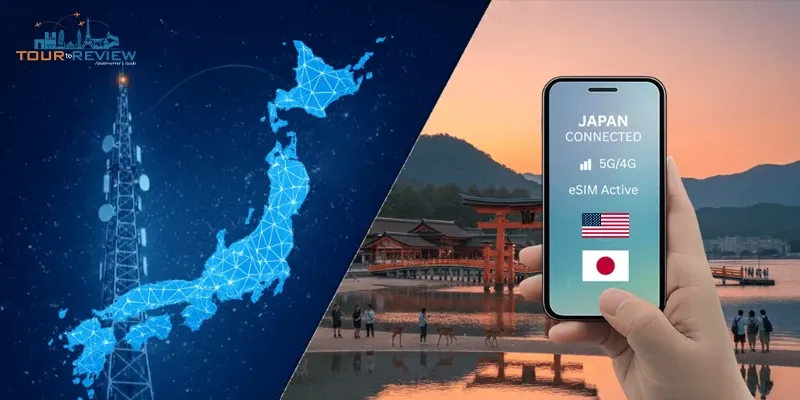
If you are flying into Japan from the USA, UK, Australia, New Zealand, Canada, or Switzerland, the smooth part is usually the flight and the airport signs. The messy part starts right after. You are looking for the right train line, scanning a pickup zone, and trying to match a street name to your map while people move around you like they have done this a hundred times.
Japan feels calm once you are connected. Stations are organised, konbini are everywhere, and even a late dinner run is easy when directions load fast, and your tickets are sitting in one place on your phone.
What to decide before you buy mobile data
Before you choose a plan, answer three simple questions:
- How many days and how many cities?
- Will you use a hotspot?
- Do you need your home number active?
Also, check the basics: your phone supports eSIM, and it is unlocked. It is a quick check that saves a lot of frustration later.
Travel eSIM (best for most travelers)
For most people, an eSIM is the easiest balance of effort and reliability. You set it up before you fly, then land with data ready. No store visits, no small SIM trays, no guessing which counter is the right one.
If you want the simplest arrival day, eSIM for Japan is usually the most practical choice. It is the difference between walking straight to the station and standing around trying to connect to the airport WiFi with tired eyes.
What this option is good for:
- Google Maps in busy station areas
- Translation for menus and signs
- Messaging your hotel or host
- Ticket apps and QR codes
- Ride bookings when it is raining or late
Home carrier roaming (easy, often expensive)
Roaming through your home carrier is convenient because you do not have to do anything. The tradeoff is cost and sometimes speed limits. Some plans start strong, then slow down once you hit a daily cap.
This option makes sense if you are in Japan for a short work trip, you need your home number for calls, or your company covers roaming.
Pocket WiFi (great for families and groups)
Pocket WiFi can still be a good option in Japan, especially for families. One device can connect multiple phones and tablets. On long train rides, that shared connection can feel like a relief.
The downside is simple: it is one more device to carry and charge. If it dies, everyone goes offline. If someone walks off with it, the rest of the group loses the connection.
Local SIM at the airport (works, but costs time)
Buying a local SIM can work, but it usually takes time when you are at your least patient. You are tired, you are hauling bags, and you are reading plan details you do not want to read. It can be fine for long stays, but for short trips, it often feels like extra effort for no real gain.
Free WiFi (good backup, not your main plan)
Japan has plenty of WiFi, but it is not a plan you can rely on for the moments that matter. It can drop underground, slow down in crowded areas, or require sign-ups when you just want to move. It is useful for a quick upload at a café, not for finding the right exit in a big station.
A simple pick for most USA to Japan itineraries
If you are moving between cities by train and doing day trips, a Japan SIM is usually the most stress-free choice. It keeps things steady through station changes, quick reservations, and all the small decisions that make a trip feel smooth.
Setup checklist before you fly
- Install the eSIM and label it clearly in your phone settings
- Download offline maps for your first city
- Screenshot your hotel address in Japanese and English
- Save key tickets and booking QR codes in one folder
- Pack a power bank for long transit days
Connectivity
Reliable internet is what keeps small problems from becoming big ones. It helps with live directions, translation, ride bookings, ticket apps, and quick changes when plans shift. If you want a smoother setup, a travel eSIM can be useful for staying online without hunting for WiFi.
If you are using Jetpac, you can expect:
- Works in 200+ destinations
- Instant QR code activation
- Prepaid 5G
- Multi-network switching
- Unlimited hotspot sharing
- Voice calls starting at USD 1.99 for 5 minutes
- 24/7 WhatsApp and email support