

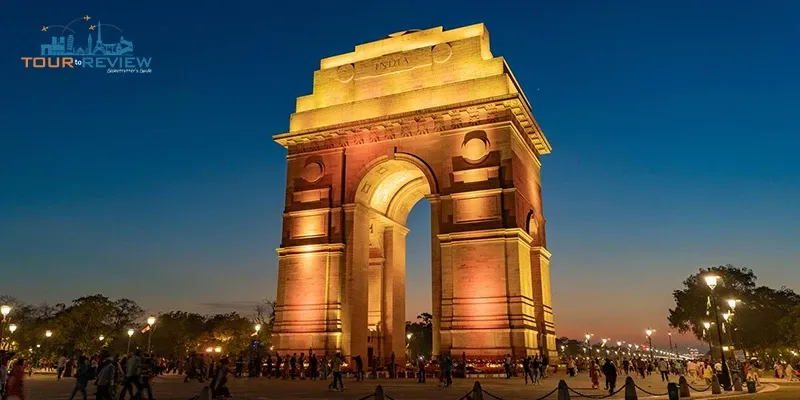
Delhi is one of those places that’s on everyone’s bucket list. People love coming here to check out the India Gate, wander through history, and just soak up the city’s energy. It’s a place that really stays with you.
But have you ever stopped and wondered why Delhi is capital of India? The city was not randomly chosen as the nation’s capital, but there is a long story behind it that may be taken for granted today. The story is fascinating and deeply rooted in history.
So when we talk about ‘Delhi’, it actually makes more sense when you understand the history.
Historic Background of Delhi- The Capital City
How many of you know that the city you dreamed of visiting or lived in once in a lifetime has the richest and longest history of any city in the world? When talking about today’s generation, barely anyone knows Delhi beyond Aunty Momos, Palika Bazar, and the other cheapest market.
Knowing about the history of the capital city is also important because it contributes to why Delhi is capital of India. So let’s take you back thousands of years ago.
According to the Indian texts and mythology, Delhi is often associated with the legendary city of Indraprastha from the Mahabharata era.
The earliest historical settlement in Delhi dates to the 6th century CE, but its prominence grew significantly during the medieval period.
Starting in the 1100s, Delhi became the main base for several Islamic rulers, beginning with the Delhi Sultanate. Leaders like Qutb-ud-din Aibak and Iltutmish turned the city into a powerful centre for government and the military
Famous spots like the Qutub Minar and old forts popped up during this period, making Delhi a total hotspot for history. It wouldn’t be wrong to say this historical vibe is why it’s the capital, but there’s actually a bit more to it than just cool old buildings!. But, not actually. There are several other reasons behind it. Let’s unfold them.
In the 16th century, the Mughals stepped in and made Delhi a huge part of their empire. Shah Jahan even built a whole new section of the city (Old Delhi), including famous spots like the Red Fort. This really cemented Delhi’s reputation as an important place to rule from. This solidifies Delhi’s identity as a significant city for ruling, indirectly, a capital.
Delhi came under the rule of the British after the Mughals. You didn’t know that later on, why Delhi is capital of India? In fact, Kolkata was the capital city of the Indian nation during its early days.
Just hang on for a while longer. It was decided by the British in 1911 that the capital would be shifted to Delhi. There are many reasons why this decision was made, such as strategic position, prestige, and easier administration. This brought about the birth of New Delhi.
So, this is about the history of Delhi. Let’s understand why Delhi became the capital of India after Kolkata.
Reasons Why Delhi is Capital of India
Now you know the history, it’s time to learn why Delhi is capital of India. Here, we have discussed a few reasons for this.
1- British Decision in 1911
The transfer of the capital officially happened in the year 1911 when King George V declared it at the Delhi Durbar ceremony. There were many reasons behind this change.
- Kolkata was becoming politically active with nationalist movements.
- Delhi provided better control over Northern India.
- It has historical prestige as discussed above.
- Delhi has central accessibility.
For these reasons, Delhi was declared the new capital of India and built as a planned city by British architects Edwin Lutyens and Herbert Baker.
2- Strategic Geographic Location
Delhi is located in northern India, almost at the centre of the nation, allowing it to govern the vast Indian subcontinent. Its location makes it accessible from all major regions of the country. The British considered it a major advantage when relocating the capital. Today, Delhi’s connectivity to other regions is evident through railways, highways, and routes, and, most importantly, the airport.
3- Continuity After Independence
Another reason why Delhi is the capital of India is that, today, it’s a tradition that works. Since 1947, the city has been the heart of the country. Keeping the capital here was a practical choice it’s well-connected, easy to reach, and moving everything to a new city would have caused way too much chaos.
4- Historic Significance
One of the main reasons why Delhi is capital of India is simply because of its massive history. It’s been the centre of power for a long time, serving as the home base for huge empires like the Mughals and the Delhi Sultanate.
From ancient times, the city has witnessed the rise and fall of multiple empires, which have also given it a strong legacy as a centre of governance. Delhi’s historical importance also made it a natural choice as the capital, with the capital shifting from Kolkata in 1911.
Recent Reasons Why Delhi is Capital of India
The capital of India shifted from Kolkata to Delhi in 1911. Now, after years, what keeps it as the capital? Let’s shed some light on it.
Administrative Efficiency
Delhi offers a highly centralised system of governance. Important institutions such as the Parliament of India, the Rashtrapati Bhavan, the Supreme Court, and key ministries are located here.
Having all major administrative bodies in one place improves coordination between different branches of government. Also, this allows faster commute and decision-making.
Symbol of National Unity
It won’t be a surprise if we say unity is one of the reasons why Delhi is capital of India. Delhi is more than a city; it represents the unity of Inida. People from all over the nation live and work here.
Even the major celebrations related to the country take place here, such as Independence Day, the Republic Day Parade, and important political gatherings.
Infrastrutcure & Connectivity
Another key reason why Delhi is capital of India is its strong infrastructure. The city is well-connected, both internally and externally. Meaning, there is
- One of the major airports, Indira Gandhi International Airport
- An extensive metro network that connects not only Delhi but also nearby areas such as Noida, Gurgaon, Faridabad, and Ghaziabad.
- National highways and rail systems.
Economic & Political Importance
Delhi is also a major economic centre, contributing significantly to India’s economy. It hosts the headquarters of major corporations, industries, and international organisations.
In other words, it is a centre of decision-making in India. Almost every major policy, law, and national decision is made here.
Delhi, The Heart of India
Now you understand why Delhi is capital of India. There is a combination of reasons from then to now, from history to the present. This city has also played a central role in shaping the nation. From being an IT hub to a home to various people from different states, hosting big events and diplomatic visits, Delhi is the heart of India. So it’s very obvious why Delhi is capital of India.